Materials → Phenolic composite
Material profile · 06/06
PHENOLIC COMPOSITE
A fabric-reinforced composite built for heavy load, high speed, and continuous duty.
- -40°C to 120°C
- Temp. range
- Very high
- Load capacity
- Low
- Friction
- Excellent
- Wear resistance
Overview
Where Phenolic composite earns its place.
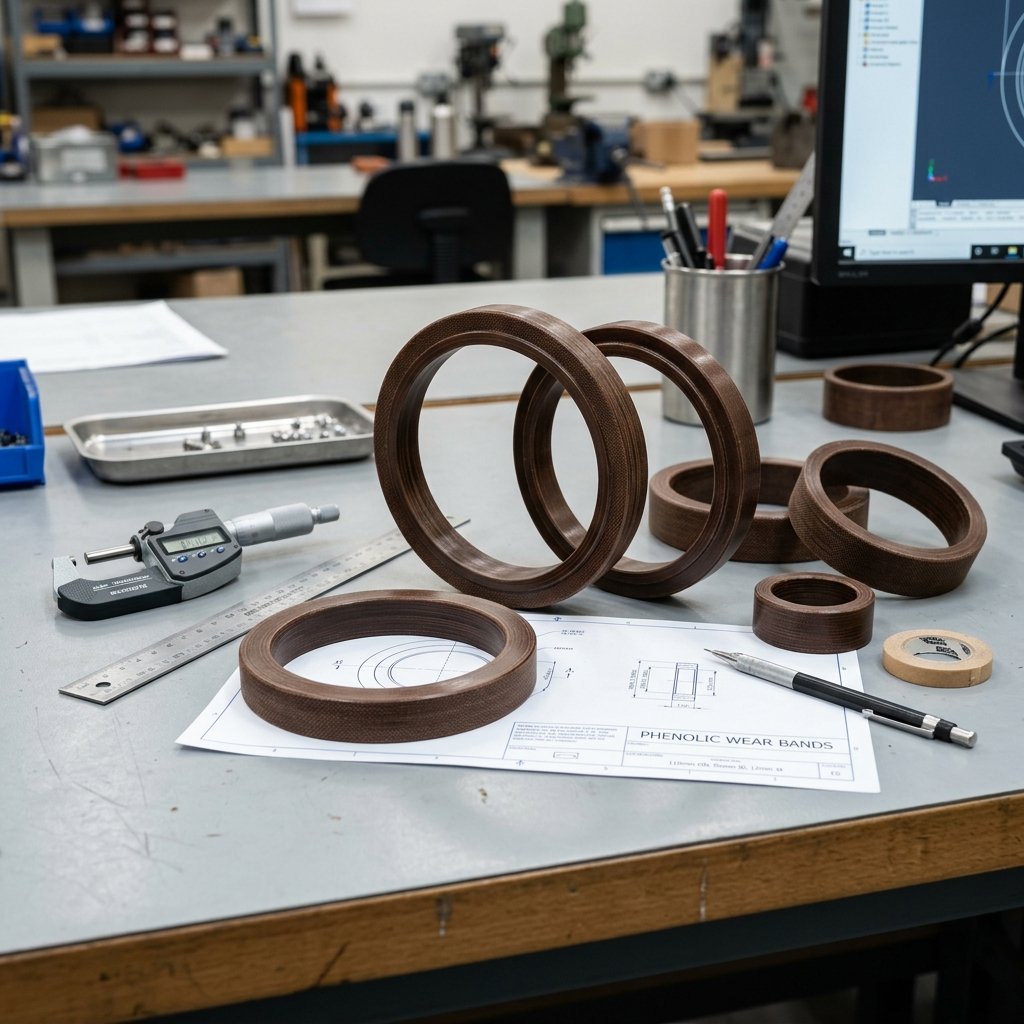
Fabric- or resin-reinforced phenolic composite is the heavy-duty alternative to POM for wear rings. It carries higher compressive and side-load than acetal, holds dimensional stability under continuous high-speed operation, and tolerates more heat — which is why it turns up in steel mill, mining, and other high-duty-cycle cylinders where wear rings see near-constant load and abrasive contamination in the fluid.
Trade-offs
Advantages and limitations.
Advantages
- Highest compressive load capacity among the common guide-ring materials.
- Excellent wear resistance under continuous, high-duty-cycle operation.
- Good dimensional stability at elevated operating temperature.
- Performs well in abrasive, contaminated fluid environments.
Limitations
- More brittle than POM under sudden impact load.
- Higher material cost than acetal for equivalent ring geometry.
- Less suited to applications needing frequent design iteration or fine machining changes.
Operating envelope
Typical technical reference.
Figures are typical for the compound family and vary by specific grade and cure. Confirm exact limits against your fluid, pressure, and duty cycle before finalising a specification.
| Operating temperature | -40°C to 120°C |
| Typical hardness | High rigidity, composite laminate |
| Friction coefficient | Low |
| Fluid compatibility | Mineral oils, abrasive/contaminated fluid duty |
| Duty type | Structural guide/wear ring, heavy load |
Compare
See the other five materials.
Engineering support
Confirm if Phenolic composite is right for your application.
Share the product family, dimensions, pressure, temperature, media, drawing, or sample photo. Fitofit will confirm the right material direction.