Sealing systems for steel mill duty cycles.
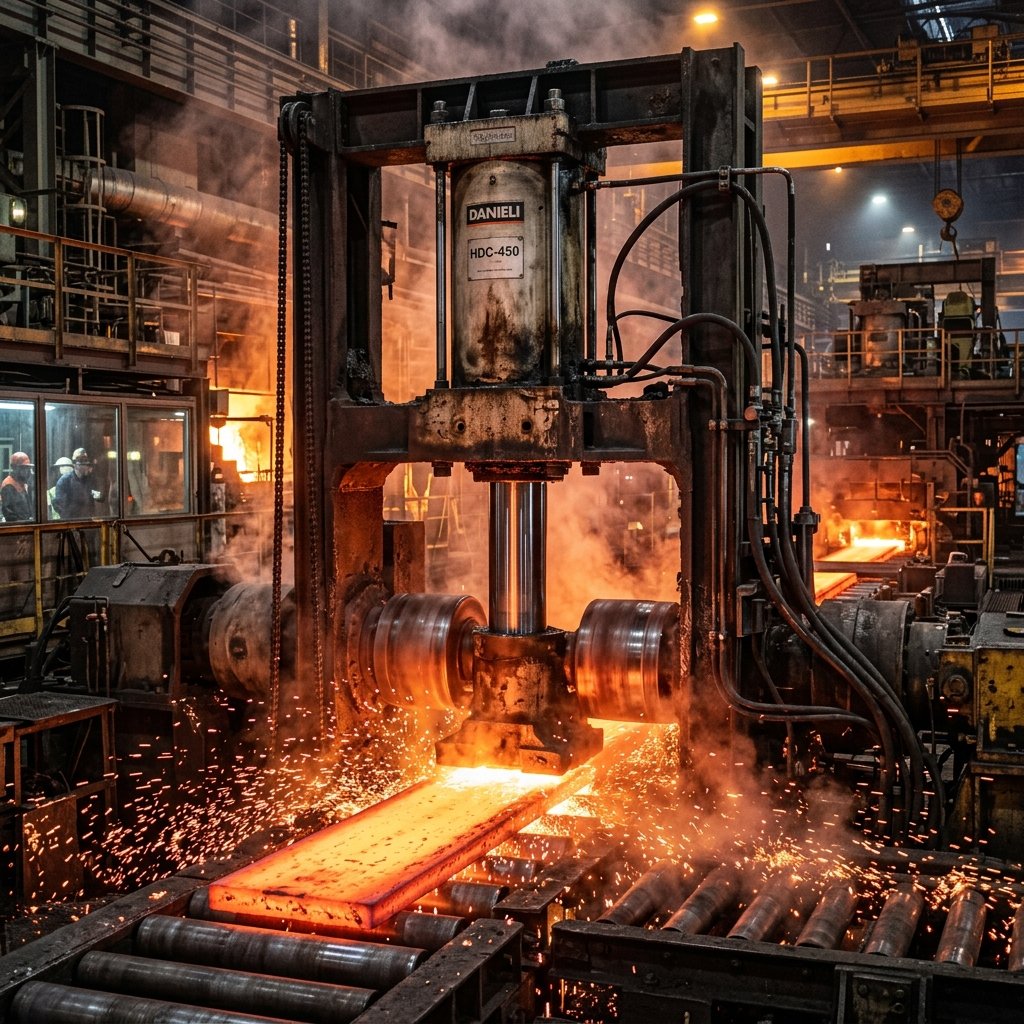
Steel mill hydraulics run under conditions most sealing catalogues never account for: radiant heat from nearby furnaces, mill scale in the air and on the rod, and shock loading from rolling and shearing operations. Standard seal selection logic breaks down quickly in this environment, and the failure cost is high because mills run continuously.
Heat is rarely just ambient temperature
The relevant number isn't the plant's ambient temperature but the localized heat the cylinder actually sees near furnaces, casters, and rolling stands. Radiant heat can push seal-face temperatures well above what the surrounding air suggests, which is why mill applications often need high-temperature compounds even when general ambient readings look moderate.
Scale and abrasive contamination
Mill scale is hard, abrasive, and constantly present near rolling operations. It behaves more like grinding grit than typical dust, and a wiper specified for general outdoor use will wear through quickly. Heavier-duty wiper profiles, often metal-cased, are standard practice in this setting.
Shock loading changes the failure mode
Shearing, piercing, and rolling operations apply sudden, high-magnitude loads rather than smooth pressure cycles. This favors seal profiles and backup ring arrangements with strong extrusion resistance, since a momentary pressure spike can extrude an underspecified seal into the clearance gap in a single cycle.
Maintenance windows are short
Mills typically schedule maintenance around production campaigns, not calendar dates, so seal life needs to comfortably outlast the operating window between shutdowns. We generally recommend specifying toward the conservative end of material and profile choices here, since an unplanned failure mid-campaign is far more costly than a slightly larger upfront material spend.
Material selection in practice
For most steel mill cylinders, this points toward high-temperature, abrasion-resistant polyurethane or filled PTFE compounds, paired with robust metal-cased wipers and properly sized backup rings on dynamic grooves. The specific combination still depends on where in the mill the cylinder sits.
If you're specifying or replacing cylinders for rolling, casting, or shearing equipment, send us the duty cycle and proximity to heat sources alongside the groove drawing — mill applications are exactly the kind of edge case where a standard catalogue seal underperforms.